Processor · Audio effect
Voxmod
Combined vocoder and ring modulator — a filter-bank vocoder and a band-limited ring modulator run in parallel and blend with Mix.
Opinion
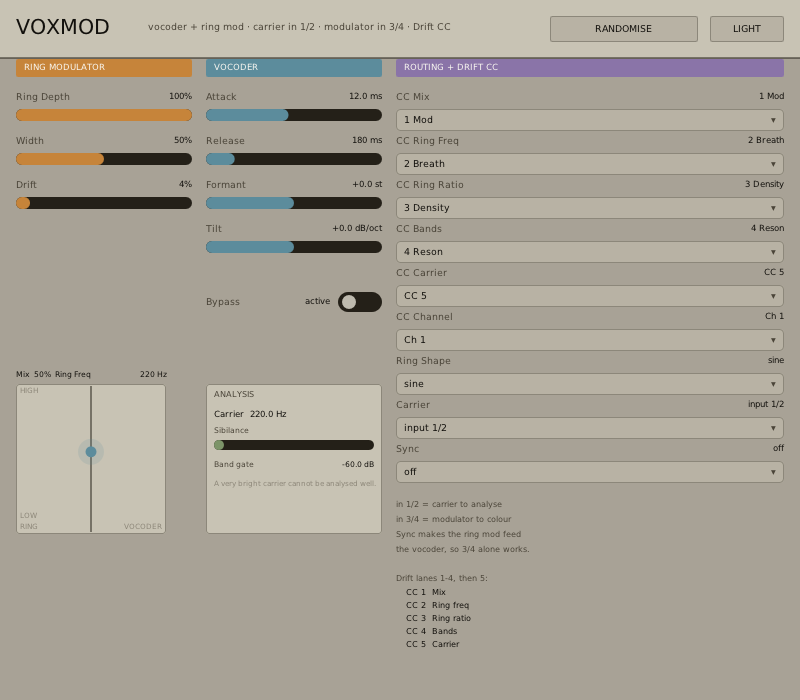
Voxmod is one plugin with two engines that share a bus rather than a mode switch, which is the whole point of it. Put a voice on inputs 1/2, an instrument on 3/4, and start at Mix 50: you get the instrument coloured by the voice’s formants with the ring modulator underneath filling the gaps. Push Mix left and the ring mod takes over and the voice stops mattering; push it right and the instrument disappears into the voice. The x-y pad on the panel is X for that balance and Y for the ring carrier frequency, because those two are how you actually explore this effect — dragging the dot around the pad changes both at once.
It wants a modulator with harmonics. A clean synth pad through the vocoder sounds like a filtered version of itself, because there is nothing in it for the carrier’s envelope to grab. A drum bus, a distorted guitar, a bowed string, anything with partials, comes alive.
Carrier is set to input 1/2 by default, which is the correct default for a
two-source setup. If you have only one thing, switch Carrier to internal osc
and the plugin analyses its own oscillator, or turn Sync on so the ring-modulated
signal feeds back as the vocoder’s carrier — either way inputs 3/4 alone are
enough.
Functionality
Two engines, one blend parameter.
The ring modulator multiplies the modulator by a band-limited oscillator at
Ring Freq × Ring Ratio. Ring Ratio is quantised to 16 musical steps from −12 to
+35 semitones, so moving it changes the sidebands in semitones and lands on the
same ratios every time, rather than sweeping continuously through a four-octave
range. Ring Depth scales the oscillator toward unity, so 0 % is a clean
pass-through and 100 % is full multiplication. The saw and square shapes are
polyBLEP-corrected: the oscillator’s job is to produce only the carrier, and
unwanted aliasing would fold broadband noise across the modulator and drown out
the discrete sidebands that make a ring modulator sound like one.
The vocoder splits the carrier into a filter bank and follows each band’s
envelope with an asymmetric follower, then applies those gains to the matching
bands of the modulator. Band edges are logarithmic across Spread octaves
because a linear bank would spend most of its bands on treble and starve the
200–1200 Hz region that actually carries vowel identity. Bands are constant-skirt
rather than constant-Q, so the resynthesis gain does not tilt with band width.
Formant transposes the modulator side of the bank only. Analysing the carrier at one frequency and resynthesising the modulator at a transposed one is what relocates the envelope that shapes the output — moving both sides together would just transpose everything and change nothing about the vowel.
Parameters
| Parameter | Range | Default | Notes |
|---|---|---|---|
| Mix | 0–100 % | 50 % | Vocoder at 100, ring mod at 0; CC 1 |
| Ring Freq | 5–5000 Hz | 220 Hz | Oscillator frequency; CC 2. Pad Y axis |
| Ring Ratio | 0.5–8 | 2.0 | 16 musical steps, −12 to +35 st; CC 3 |
| Ring Shape | sine…square | sine | Band-limited with polyBLEP |
| Ring Depth | 0–100 % | 100 % | 0 % is a clean pass-through |
| Bands | 4–64 | 24 | Filter bank size; CC 4 |
| Spread | 1–8 oct | 5 oct | How much spectrum the bank covers |
| Attack | 1–200 ms | 12 ms | Envelope follower, time-based |
| Release | 20–1000 ms | 180 ms | Envelope follower, time-based |
| Formant | −12–+12 st | 0 st | Moves formants, not the band grid |
| Tilt | ±12 dB/oct | 0 | Per-band gain, leans the spectrum |
| Carrier | input/osc | input | What the vocoder analyses; CC 5 |
| Sync | off/on | off | Ring mod feeds the vocoder’s carrier |
| Width | 0–100 % | 50 % | Ring mod widens, vocoder stays centred |
| Drift | 0–50 % | 4 % | Slow ±40 cent wobble on the carrier |
| Bypass | off/on | off | DSP keeps running |
| Randomise | trigger | — | Builds a new plausible patch |
Width exists because the two engines are not equally stereo. The ring modulator inherits the modulator’s own stereo image; the vocoder is inherently mono. So widening pushes the ring mod out and leaves the vocoder centred, which means the control does something useful at every Mix position instead of only at the ring-mod end.
Drift routing
Route Drift’s MIDI output to Voxmod’s MIDI input. With default settings CC 1 →
Mix, CC 2 → Ring Freq, CC 3 → Ring Ratio, CC 4 → Bands, CC 5 → Carrier. CC 1–4
are Drift’s default lanes; each control’s CC number is a dropdown in the panel
and off disables that override. CC Channel selects which MIDI channel is
listened to.
Randomise
Draws carrier frequency, ratio, shape, band count, spread, formant and tilt from the seed, rounded to values someone would actually pick. It advances the seed so a second press differs, and it is reproducible from the seed alone. Mix and Bypass are left alone, so randomising mid-performance does not change the balance between the two engines.
Status
The panel reports the effective carrier frequency, a Sibilance meter showing the share of carrier energy in the top bands, and the band gate’s reduction in dB. Sibilance is worth watching: a carrier with a lot of energy above the top of the bank cannot be analysed well, and the meter switches to a warning colour above 0.7 because a bright carrier will produce a thin, hissy result.
Core DSP, deterministic tests, the VST3 target, the panel and the catalog screenshot are complete. Host validation in REAPER is pending.