Instrument · Instrument
Strata
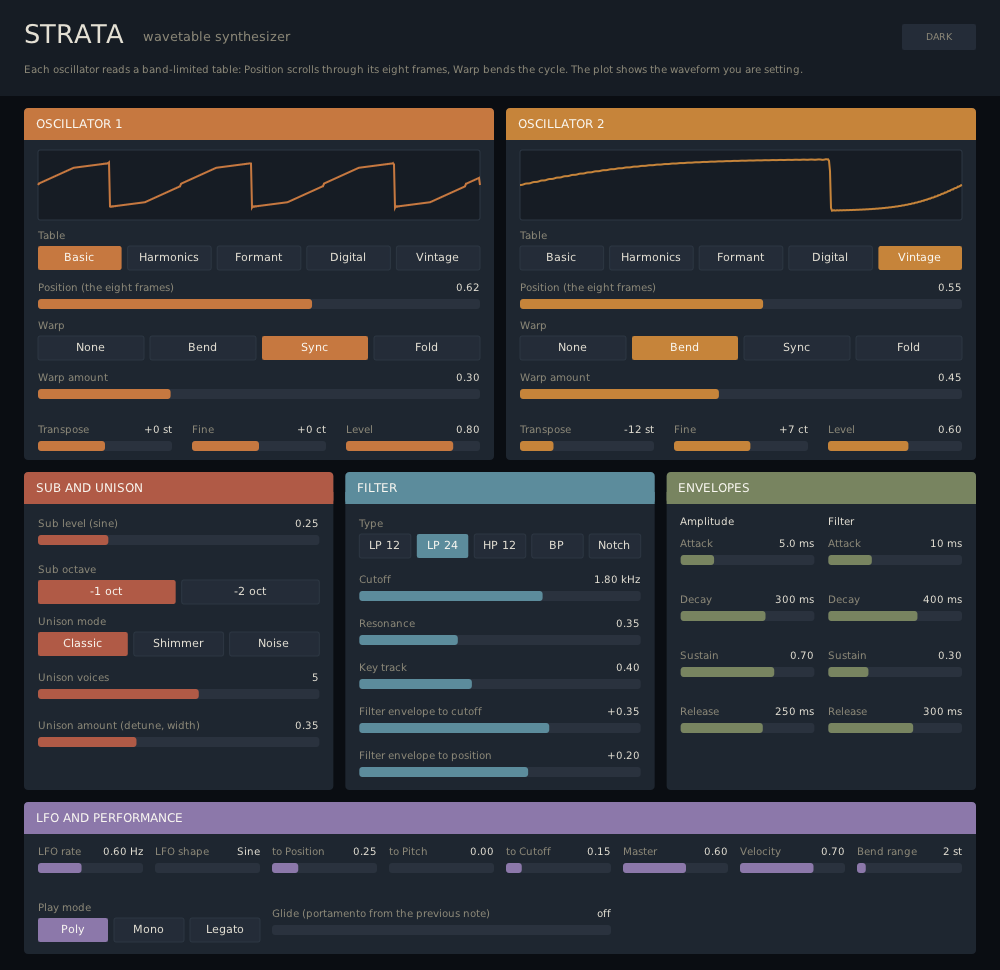
An eight-voice wavetable synthesizer with band-limited tables, Bend, Sync and Fold warps, a sine sub, unison, a multimode filter, two envelopes and an LFO.
Opinion
Not yet auditioned in a host. Downspout had no general-purpose synthesizer, so this is the one to reach for for pads, leads and basses you want to sweep: scroll Position through a table while an envelope or the LFO moves it, warp the cycle for harder timbres, and thicken it with unison. It is a redesign, not a copy of the Oxide Studio device that inspired it, whose tables alias at high notes and whose unison cancels the fundamental when Amount is 0.
Functionality
Two oscillators each read one of five table families (Basic: sine to triangle to saw to square; Harmonics; Formant: a vowel sweep; Digital: FM and fold; Vintage: a saturated saw). Each family has eight frames and Position scrolls through them with a crossfade. The tables are stored in 21 band-limited versions and the oscillator reads the one that stays under Nyquist for the pitch it is playing, so a high note stays clean: a square wave measures -77 to -89 dB away from its harmonics at every pitch, against -12 to -25 dB for the same table read naively.
Warp
Bend moves the middle of the cycle, Sync restarts it up to eight times faster (the classic hard-sync sound), and Fold folds the waveform back on itself (antialiased). Warping a band-limited table makes content beyond Nyquist that cannot be removed afterwards; at note 60 and amount 0.7 the aliasing measures -42.6 dB (Bend), -38.5 dB (Sync) and -33.1 dB (Fold). The plot above the Table control shows the waveform through the warp.
Parameters
| Group | Controls |
|---|---|
| Oscillator 1 and 2 | Table, Position, Warp, Warp amount, Transpose +-24 st, Fine +-50 ct, Level |
| Sub | Level, Octave (-1 or -2) |
| Unison | Mode (Classic, Shimmer, Noise), Voices 1-8, Amount |
| Filter | Type (LP 12, LP 24, HP 12, BP, Notch), Cutoff, Resonance, Key track, Envelope to cutoff, Envelope to position |
| Envelopes | Attack, Decay, Sustain, Release for the amplitude and the filter envelope |
| LFO | Rate, Shape (Sine, Triangle, Saw, Square, S&H), to Position, to Pitch, to Cutoff |
| Performance | Master, Velocity, Bend range, Play mode (Poly, Mono, Legato), Glide |
Unison
At Amount 0 all unison voices play in step, so the level and the fundamental stay the same however many voices you ask for. Raising Amount spreads their detune (up to +-50 cents in Classic) and their stereo position. Shimmer lifts odd voices by up to an octave; Noise adds a slow random drift to each voice.
Playing it
MIDI notes with velocity (the Velocity control sets how much it matters), pitch bend over Bend range, the sustain pedal (CC 64), and CC 120 and 123 for all sound off and all notes off. Eight voices; a ninth note steals the quietest. Every control is an automatable parameter.
CPU
About 2 % of a core for one note and 9 % for eight at the defaults; 28 % for eight notes with 8 unison voices on both oscillators and the 24 dB filter. The heaviest setting (Fold on one oscillator and Sync on the other with that much unison) reaches about 90 % of a core.
Status
Core covered by tests (300 checks, also under ASan/UBSan): the tables’ definitions, normalisation, band limits and reads; pitch to half a cent; aliasing against a naive read; warps and their DC; unison level and width; the filter against its model; envelope and LFO shapes; voices, pedal, panic and velocity; sample-accurate events; every control; stability at 44.1 to 192 kHz; the parameter table against the core. Not yet listened to or validated in a host. No oversampling, table import, modulation matrix, a per-voice rather than global glide.