Generative · MIDI generator
Sprout
A grammar is rewritten generation by generation and played as a scale-quantised line, optionally growing one generation every few bars.
Idea from Subsequence — a Python generative sequencer that offers L-systems among its algorithmic building blocks. Sprout’s grammars, turtle reading and code are original.
Opinion
Not yet auditioned in a host. Expect self-similar phrases: the repeating shapes of an L-system are audible as motifs that return at different scales, which is different from the randomness of most generators.
Functionality
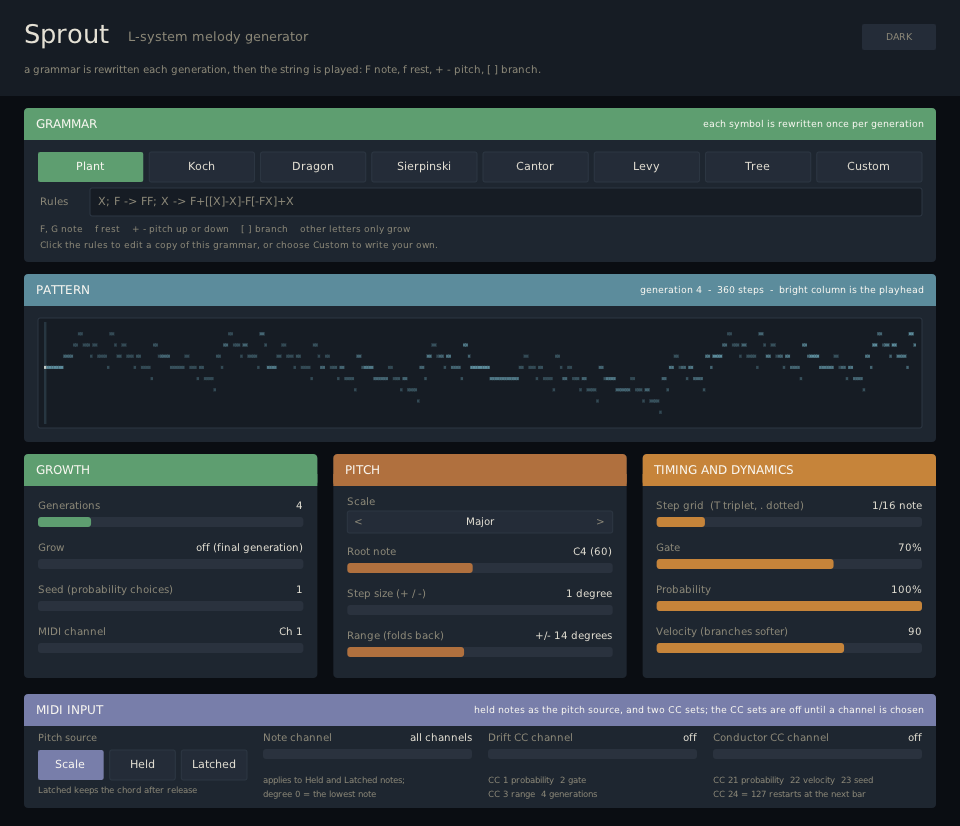
Choose one of seven grammars (or write your own, below) and a number of generations. Each generation rewrites every
symbol by the grammar’s rules, and the final string is read like a turtle: F and G
play a note, f is a rest, + and - move the pitch up or down by Step size scale
degrees, [ and ] start and end a branch that returns to the pitch it left, and any
other letter only grows. Pitch folds back at Range degrees from the root, branches
are softer, and the first step of each pass is accented. Probability thins the notes
(seeded, so a pass repeats exactly).
The pattern is locked to the host transport and loops. With Grow every above zero the pattern starts at generation 1 and gains a generation every N bars until it reaches Generations, restarting at each change. Up to 16 generations are allowed, but expansions are limited to 131,072 steps, so each grammar stops at the deepest generation that fits and Grow stops there too. Most generations each grammar reaches: Plant 7, Koch 6, Dragon 15, Sierpinski 9, Cantor 10, Levy 14, Tree 6. The Pattern plot condenses long patterns to one column of pitch range per few pixels.
Scales use the canonical order in docs/scales.md.
Writing your own grammar
Choose Custom and the Rules field becomes an editor. Click it and type: the starting
string first, then the rules, separated by ;, for example F; F -> F[+F]F. A rule’s
left side is one letter and its right side any of the letters and + - [ ], so
X; F -> FF; X -> F+[[X]-X]-F[-FX]+X is the Plant grammar. Clicking the rules of a
built-in grammar copies them into the editor, which is the quickest way to start from
something that works and change it.
It applies as you type, and the Pattern plot shows the result straight away. Text that does not parse is flagged in red under the field and ignored, so the last valid grammar keeps playing. The text is saved with the project. Up to 16 rules and 240 characters; Ctrl+V pastes, and Enter or a click elsewhere finishes editing.
MIDI input
Sprout has one MIDI input, and everything on it is off until you choose it, so an unmodified project behaves exactly as before.
Pitch source: Held or Latched. Instead of a scale, the turtle’s degrees are mapped onto the notes currently held on the input. Degree 0 is the lowest held note, and degrees are spread across the held tones at about seven degrees per octave, so Range spans a similar number of octaves whatever the chord size (a triad gets 0, 0, 0, 1, 1, 2, 2 for degrees 0 to 6, then the next octave). With nothing held (or latched) the pattern rests; there is no fallback to the scale. Root note and Scale are unused in this mode. Note channel limits which channel’s notes count (0 = all). The natural source is a chord generator in front of it (Harmonic Atlas, Cadence, ArpGen), which makes Sprout’s self-similar contours follow the harmony. Held notes are tracked from note-on, note-off and note-on with velocity 0, and cleared by all-notes-off (CC 123 or 120).
Held plays the keys that are down now. Latched keeps the chord after the keys are released, like an arpeggiator’s latch: the first note pressed once every key is up replaces it, and notes added while a key is still down join it. All-notes-off clears it, and switching back to Held drops it. Use Latched when the chord source gates its notes, or to play a chord and let go.
Drift CC channel (CC set 1, off at 0). On that channel, CC 1 sets Probability, CC 2 Gate, CC 3 Range and CC 4 Generations, each scaled across the parameter’s range. These match Drift’s default lanes, so Drift into Sprout needs no setup.
Conductor CC channel (CC set 2, off at 0). On that channel, CC 21 (Density) sets
Probability, CC 22 (Energy) Velocity, CC 23 (Mutation) Seed, and CC 24 = 127 (Reset) restarts the
pattern at the next bar line. CC 20 (Scene) is not used. See docs/midi-mapping.md.
Notes on timing and behaviour:
- MIDI is applied at the start of each host block, so a note or CC takes effect on the first step that begins in that block or later.
- The CC sets write through to the parameter values, so the panel, automation and controller agree on what the plugin is using. The editor does not move while a CC is driving it (DPF has no DSP-to-panel path for that), and the last writer wins.
- Generations is now read once per bar, so a change from the panel, automation or CC 4 lands on a bar line instead of mid-bar. Constant settings are unaffected.
- The CC-driven result is repeatable on an offline render only if the same MIDI is replayed. A restart request that never reaches a bar line is dropped when the transport stops.
Status
Core and wrapper are covered by deterministic tests. The grammars are built in: there is no rule editor yet.