Dynamics, Gating & Mixing · Audio effect
Silken
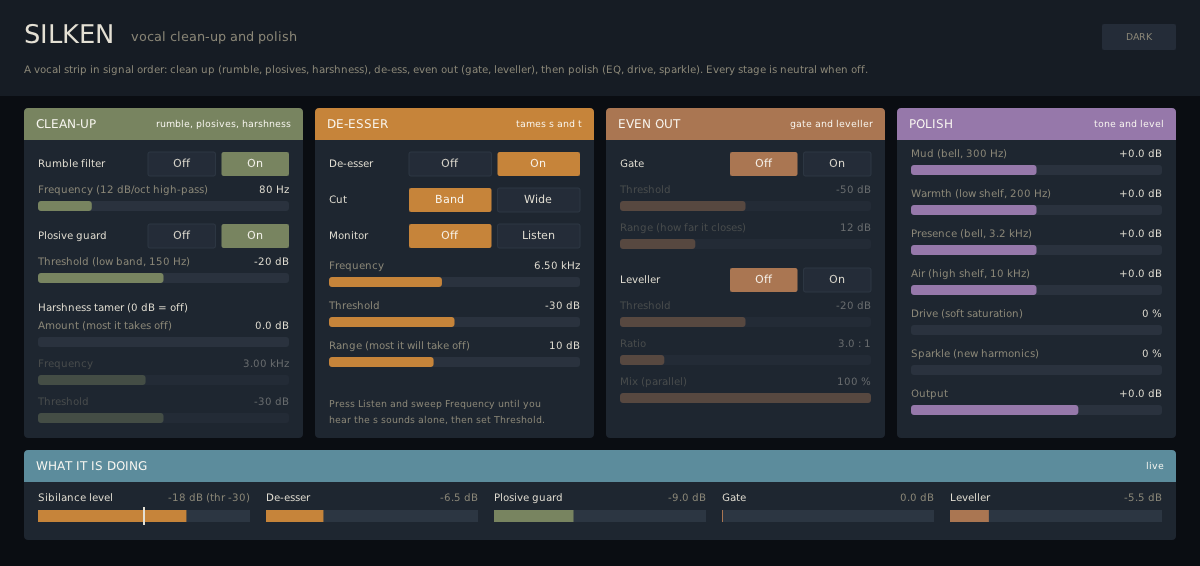
A vocal strip with a rumble filter, plosive guard, gate, harshness tamer, de-esser (band or wide, with listen), leveller, mud / warmth / presence / air EQ, drive, sparkle and output level.
Opinion
Not yet auditioned on a real voice. The defaults are protective rather than coloured: an 80 Hz rumble filter, a plosive guard at -20 dB and a de-esser at 6.5 kHz that only wakes up when the sibilance is well above the rest of the voice, with the EQ and sparkle at zero. Gate and Leveller are off by default (they depend on the recording); try the Leveller at 3:1 with a threshold near the quieter words, and the Harshness tamer at 3 kHz if a take is edgy. Put it first on a vocal, press Listen and sweep the de-esser Frequency until you hear the s sounds on their own, then pull the Threshold down until the meter just moves on them.
Functionality
In signal order: Rumble Filter (high-pass), Plosive Guard (a detector on the band below 150 Hz that fades the signal towards a high-pass when a breath burst arrives), Gate (2:1 expander with a Range), Harshness tamer (a dynamic bell cut at 1.5-5 kHz, off at 0 dB), De-esser (a two-stage band-pass detector, linked across both channels; Band cuts a bell at the frequency, Wide turns the whole signal down; Range limits it; Listen plays the detector), Leveller (a compressor with a Threshold, Ratio, parallel Mix and automatic make-up), then Mud (300 Hz bell), Warmth (low shelf), Presence (bell at 3.2 kHz), Air (high shelf at 10 kHz), Drive (soft saturation), Sparkle (adds harmonics of the top end) and Output. Every stage is exactly neutral when it is off, and the panel’s meters show the sibilance level against the threshold and the gain reduction of each dynamics stage. No latency.
Status
Core covered by tests (301 checks) against formulas worked out by hand: the rumble filter curve, the plosive, gate, tamer, de-esser and leveller curves, ranges and timing, vowel rejection, Band against Wide, the EQ gains, drive and sparkle harmonics, block-size independence and idle decay. The times, ratios and corner frequencies are by ear and have not been tried on real vocals or in a host.