Instrument · Instrument
Quartet
An eight-voice four-operator FM synthesizer with eleven algorithms, band-limited sine, saw and square operators, per-operator envelopes, feedback, optional 2x oversampling, a pitch envelope and a filter.
Opinion
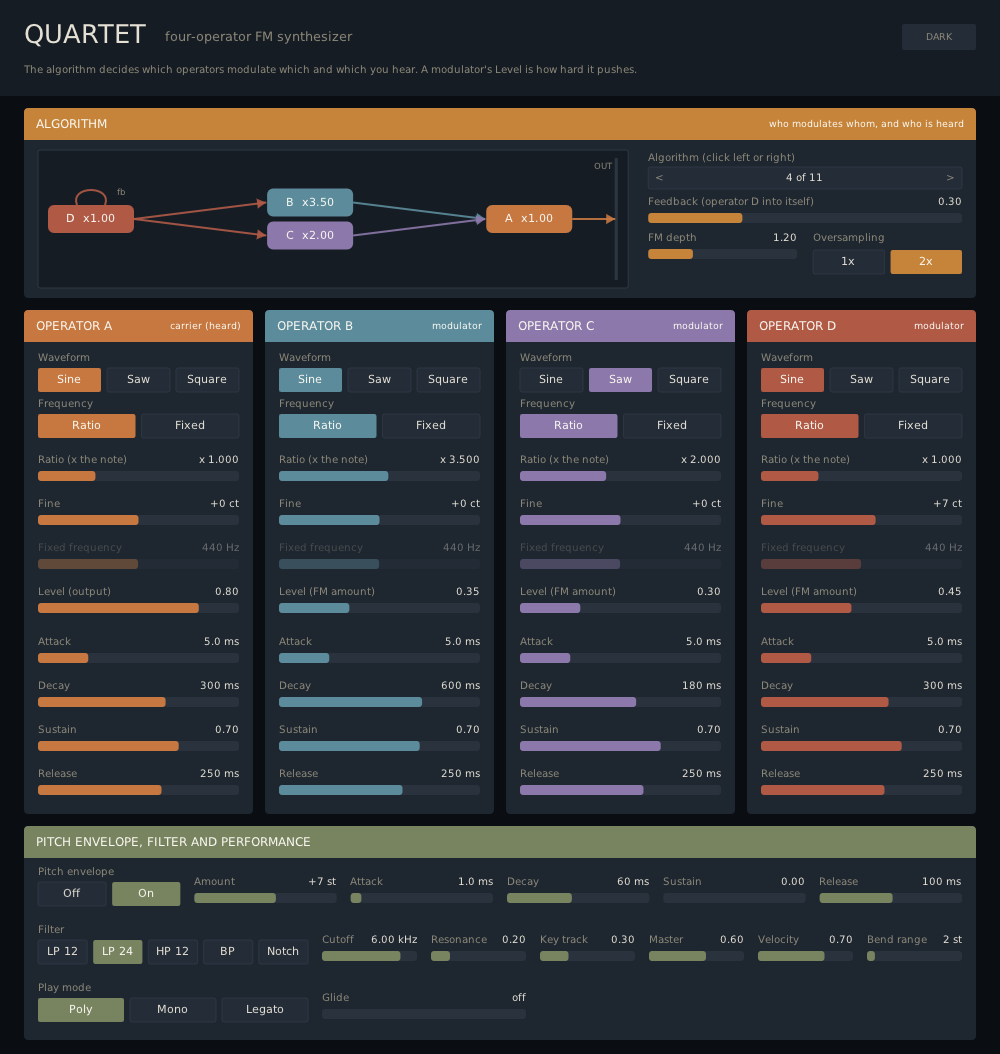
Not yet auditioned in a host. Downspout had no FM synthesizer, so this covers electric pianos, bells, plucks, metallic basses and the classic digital pad. The panel draws the algorithm as a diagram, so you can see which operator is pushing which before you touch a slider. It is a redesign, not a copy of the Oxide Studio device that inspired it, whose default modulation index is about 19 radians and whose “fine” tuning moves a frequency by up to an octave.
Functionality
Each of the four operators (A to D) is a sine, a saw or a square, with a frequency that is a multiple of the note (Ratio, with Fine in cents) or a Fixed value, a level and its own ADSR envelope. The algorithm decides how they connect: in algorithm 1 D modulates C, which modulates B, which modulates A, and only A is heard; in algorithm 11 all four are heard and none modulates. A modulator’s Level is how far it pushes its target’s phase, and FM Depth sets the scale: the modulation index in radians is 2 pi x depth x level, so a depth of 1 and a level of 0.16 is an index of 1. Operator D can feed back into itself for a raspier tone.
Algorithms
(> means modulates.) 1 D>C>B>A; 2 (C+D)>B>A; 3 (B + D>C)>A; 4 D>(B+C)>A; 5 (B>A) + (D>C); 6 (B+C+D)>A; 7 A + B + (D>C); 8 A + (D>C>B); 9 A + ((C+D)>B);
10 D>(A+B+C); 11 A+B+C+D. Carriers are averaged, so more carriers do not mean more level.
Parameters
| Group | Controls |
|---|---|
| Per operator | Waveform, Ratio or Fixed, Ratio 0.25-32, Fine +-50 ct, Fixed Hz, Level, Attack, Decay, Sustain, Release |
| FM | Algorithm, Feedback, FM Depth 0-4 cycles, Quality (1x or 2x oversampling) |
| Pitch envelope | On, Amount +-48 st, ADSR |
| Filter | Type (LP 12, LP 24, HP 12, BP, Notch), Cutoff, Resonance, Key track |
| Performance | Master, Velocity, Bend range, Play mode (Poly, Mono, Legato), Glide |
Clean at the top
The saw and square operators are band-limited (inharmonic power at most -77 dB at every pitch). FM itself can still alias: high-index FM at a high pitch has sidebands far beyond Nyquist. The Quality switch runs the voice at twice the sample rate and decimates with a 63-tap half-band filter (flat to 18 kHz within 0.001 dB, -89 dB stopband). On a deliberately extreme three-stage patch this lowers the aliasing from -17 to -53 dB at note 72, from -8 to -26 dB at note 84, and from -2 to -8 dB at note 96. Keep the depth and levels moderate for the top octaves.
Playing it
MIDI notes with velocity (Velocity sets how much it matters), pitch bend over Bend range, the sustain pedal (CC 64) and CC 120 and 123. Eight voices; a ninth note steals the quietest. Mono voices summed to a stereo output (both channels identical). About 5 % of a core for eight notes at 1x and 13 % at 2x.
Status
Core covered by tests (493 checks, also under ASan/UBSan): the waveform tables and their band limits, the decimator’s response, the algorithm table and every declared routing, the FM sidebands against Bessel functions (exact to four digits), pitch to half a cent, feedback, aliasing with and without oversampling, DC, the pitch envelope, the filter against its model, envelope shapes, voices, pedal, panic and velocity, sample-accurate events, every one of the 59 controls, and stability at 44.1 to 192 kHz. Not yet listened to or validated in a host. No user-drawn waveform, key or velocity scaling per operator, or 4x oversampling.