Delay, Reverb & Space · Audio effect
Prism
Splits the sound into 1-8 frequency bands and delays each one separately on the left and right, in milliseconds or note divisions of the host tempo, with its own feedback. Per-band solo, low and high cut, four FFT sizes.
Opinion
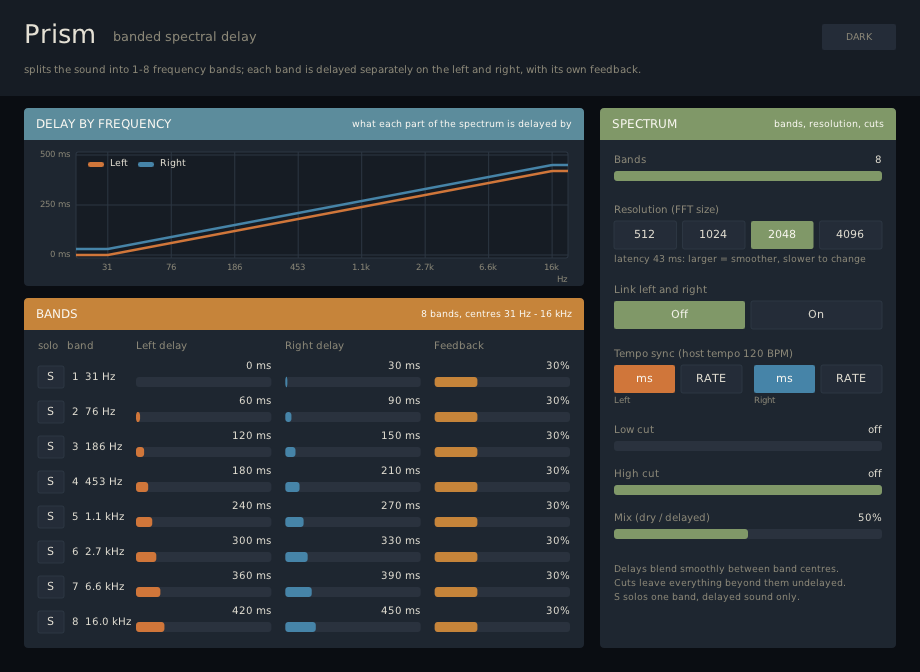
An echo that does not treat the spectrum as one thing. With the defaults the lows arrive first and the highs trail behind by nearly half a second, so a snare or a chord smears upward into a shimmer; flip it (long lows, short highs) and the same material blooms from the top down. The right channel is offset from the left, so the smear also spreads across the field.
It is most at home on sustained or rhythmic material: pads, drum loops, a full mix on a send. Feedback turns each band into its own repeating tail; with a few bands at different times you get interlocking, slowly decaying patterns that a normal delay cannot make. The delay by frequency plot on the panel shows the shape you have made. Solo a band to hear what it is contributing.
It is a creative effect, not a precise one: delays between band centres are blended, not exact, and repeats lose a little level at some delay times.
Functionality
An overlapping short-time Fourier transform (square-root Hann windows, 8x overlap) runs on each channel. Every frequency bin is read back from the spectrum stored some whole number of frames ago; the remainder, under half a hop, is applied as a phase rotation and corrected for the level it costs through the windows. A bin’s delay and feedback come from the band values, interpolated linearly in log frequency between band centres (31.25 Hz to 16 kHz, evenly spaced in octaves), so there is no step at a band edge. Band values are smoothed over about 100 ms so turning a control does not click.
The stored spectrum is the input plus the feedback times the delayed spectrum, so each repeat is late by the full delay. Bins with no whole-frame delay get no feedback (it would be a zero-delay loop). Solo and the rotation correction affect only what is heard, never the loop.
Tempo sync. Each side (left, right) has an ms / RATE switch. In RATE mode every band picks a note division (1/64 to 1/1, with triplets and dotted values) of the host tempo (the BBT tempo; 120 BPM if the host gives none), so the echoes sit on the beat at any tempo, with a different division per band for polyrhythmic smears. A division longer than 2 s at the current tempo is limited to 2 s and the panel says so. Tempo changes glide rather than click.
Low Cut and High Cut fade the delay and feedback out over a third of an octave and leave everything beyond them undelayed; each is off at the end of its range. Link L/R makes the right delays follow the left. Mix is dry against delayed; while a band is soloed only the delayed sound is heard.
The dry path is delayed to match, and the latency (the FFT size: 11-85 ms at 48 kHz) is reported to the host and shown on the panel. Changing Resolution clears the delay memory.
Parameters
| Parameter | Range | Default | Notes |
|---|---|---|---|
| Bands | 1-8 | 8 | Bands beyond it are kept but unused |
| Resolution | 512, 1024, 2048, 4096 | 2048 | FFT size, sets latency |
| Low Cut | 20 Hz-2 kHz | off (20 Hz) | |
| High Cut | 200 Hz-20 kHz | off (20 kHz) | |
| Mix | 0-100 % | 50 % | |
| Link L/R | Off, On | Off | Right follows left, including sync and division |
| Sync L, Sync R | ms, RATE | ms | RATE: bands use their note divisions |
| Band n L Delay | 0-2000 ms | 60 ms x (n-1) | |
| Band n R Delay | 0-2000 ms | 60 ms x (n-1) + 30 | |
| Band n L / R Division | 1/64 … 1/1 (13) | 1/8 / 1/8D | Used while that side is RATE |
| Band n Feedback | 0-95 % | 30 % | |
| Band n Solo | Off, On | Off |
Origin
The technique (per-bin delay in the STFT domain with band interpolation, fractional delay by phase rotation, feedback through the stored spectra) follows the published description of the Multiway plugin by Mustafa Mazi. It was reimplemented from that description; no Multiway code was used, as Multiway is AGPLv3 and Downspout is MIT. Prism has no LFOs or drawn shapes.
Status
Core DSP, about 6 900 deterministic checks, the VST3 target and the catalogue screenshot are complete. It has not been auditioned and has not been run in a host, so latency reporting, host tempo handling and resolution switching under automation are unverified outside the test rig.