Instrument · Instrument
Pratt
Eleven General MIDI voices and a stable all-pole filter, all shaped by the factorisation of an integer index — play it, filter audio with it, or both.
Based on pratt-synth — the original Pratt-polynomial MIDI synthesizer and sonification code (Python, offline renderer, with the source paper and example recordings). Pratt is a real-time port of that work; the voice spectra match the original renderer to within 0.12 dB.
Opinion
An odd and likeable instrument: neighbouring keys have unrelated spectra because their indices factor differently, so a scale sounds slightly “alive” in a way ordinary filtered oscillators do not. The filter is gentler than it looks on paper — low indices are smooth low-passes, and the interesting territory is in the composites, where cascading Index A and Index B stacks poles in pairs that only the number theory predicts. Treat the drums as a bonus, not a kit.
Functionality
Pratt is a real-time port of the offline pratt-synth renderer. Everything comes
from the Pratt polynomials: f_1 = 1, f_2 = x, f_p = 1 + f_{p-1} for odd
primes, multiplicative otherwise, with f_n(2) = n. The filter
H_n(s) = n / f_n(2 + s/w0)
is all-pole, has unity gain at DC and is strictly stable (poles at least 0.99 w0
into the left half plane for every n up to 8192). Because H_m H_n = H_mn,
two index controls cascade into one filter of index A x B.
Synth mode. Each note gets index n = (note + 1) x base; partial k of the
note is weighted by k^-roll * H_n(i xi k) using both magnitude and phase, then
summed into a band-limited table. Eleven families follow the General MIDI
program (or can be fixed): piano, electric piano, organ, pluck, bass, strings,
brass, reed, flute, pad and timpani. Sustain pedal, channel volume, expression,
pan and pitch bend are handled; channel 10 plays procedural drums (a swept-sine
kick, the rest noise through H_(note+1)). A fixed 14-tap diffuse room and a
soft clip finish the voice path.
Timbre Index. A large Pratt base darkens a voice but also washes out the
key-to-key variation, because the same factors are multiplied into every note.
Timbre Index instead cascades one fixed filter H_timbre onto every note
(H_mn = H_m H_n), so the character from (note + 1) x base stays and the
chain only adds roll-off. It defaults to 1, which adds nothing; it is applied when
a wavetable is built, so it costs no extra time per sample at any setting.
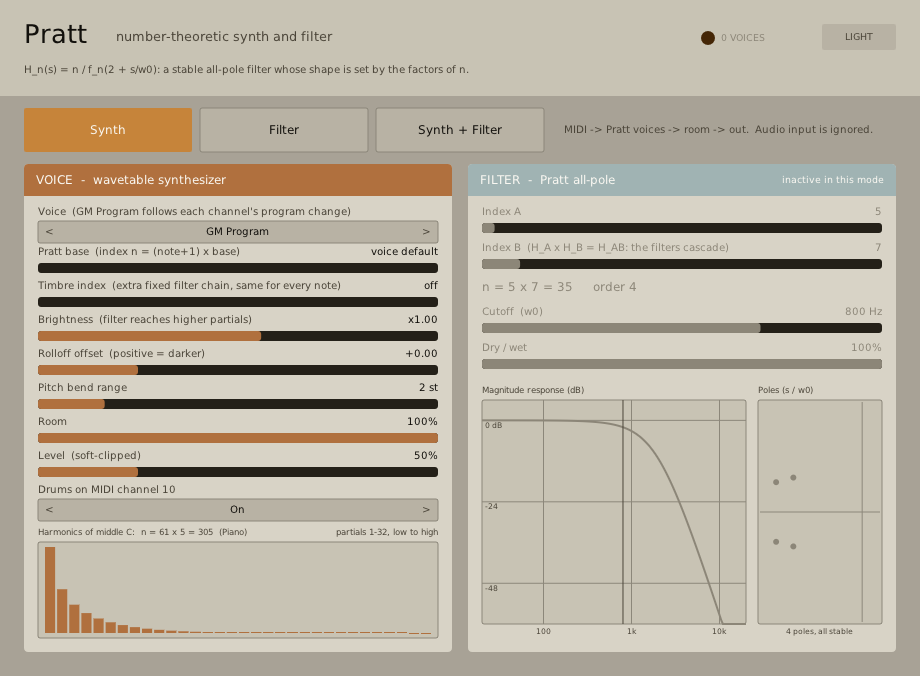
Filter mode. Audio in goes through the Pratt filter at the chosen cutoff with a dry/wet mix. The panel plots the magnitude response and the poles. Synth + Filter sums the voices and the audio input before the filter.
The voice wavetables are built on a background thread after the plugin is activated, so the first chord does not pay for them.
Parameters
| Parameter | Range | Default | Notes |
|---|---|---|---|
| Mode | Synth, Filter, Synth + Filter | Synth | Signal flow is shown on the panel |
| Voice | GM Program + 11 families | GM Program | Fixed voice overrides program changes |
| Pratt Base | 0–64 | 0 | 0 uses the voice’s own base; n = (note + 1) x base |
| Timbre Index | 1–8192 | 1 (off) | Extra fixed filter chain H_timbre on every note; darker, key-to-key character kept |
| Brightness | 0.25–3.0 | 1.0 | More partials pass |
| Rolloff | −0.5 to 1.5 | 0 | Positive is darker |
| Bend Range | 0–12 st | 2 | RPN is not parsed |
| Drums Ch10 | Off, On | On | Procedural percussion |
| Room | 0–100 % | 100 % | Fixed 14-tap send |
| Level | 0–200 % | 50 % | Ahead of a soft clip |
| Index A / Index B | 1–128 / 1–64 | 5 / 7 | Effective index A × B, capped at 8192 |
| Cutoff | 20–4000 Hz | 800 Hz | Clamped to 0.1 × sample rate |
| Filter Mix | 0–100 % | 100 % | Dry/wet |
Status
Core DSP, voice parity with the Python renderer (within 0.12 dB), deterministic core, engine, state and threading tests (the last also clean under ThreadSanitizer), the VST3 target and the catalogue screenshot are complete. Drum levels have not been tuned by ear, and host validation in REAPER remains.