Instrument · Instrument
Plank
Eight-voice polyphonic synthesizer for the Launchpad grid, with a Plinky-derived wavetable voice and Plonk-style resonator engines.
Opinion
Plinky is the best eight-voice synth I have ever owned and the grid mapping is the obvious thing to do with it, so this one is less a sound design exercise than a translation. The column-per-string layout is the part worth stealing: on almost every grid instrument the polyphony is an implementation detail, and here it is the interface.
Functionality
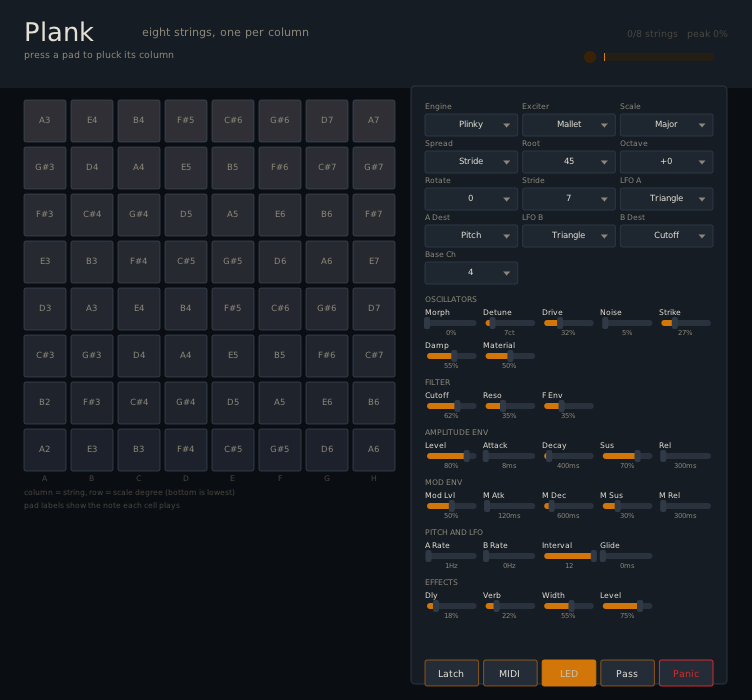
Plank is an eight-voice polyphonic synthesizer played from a Launchpad’s 8 x 8 grid. Each column is one monophonic voice and each row a degree of the current scale, so the polyphony is something you hold rather than something the plugin finds for you. Every pad on the screen is labelled with the note it plays.
A voice is one of two things, chosen with Engine:
- Plinky’s wavetable voice, re-implemented as a portable C++ core: a polyBLEP oscillator pair, a morph axis into seventeen band-limited wavetables, Plinky’s resonant two-pole filter and two envelopes.
- A struck resonator, after the Intellijel/AAS Plonk Eurorack module: a mallet or
noise burst excites eight resonant modes tuned like a bar, marimba, drumhead, membrane,
plate or string.
Strike,DampandMaterialshape it;Morphbecomes the strike’s hardness.
Both go through the same tape delay, shimmer reverb, mid/side width and soft output stage.
Top buttons on the Launchpad step octave and morph, engage latch, raise drive and
resonance, toggle LED feedback, and panic; side buttons pick a performance scale. Selectors
in the UI open drop-down lists. See plugins/plank/docs/layout.md for the full surface.
The strings are tuned against each other by Spread. The default, Stride, is Plinky’s own
rule: each string a set number of semitones above the last (7 by default, roughly a fifth),
snapped to the nearest note of the scale so it never leaves the key.
Status
Playable and building, with deterministic core tests for the pitch mapping, every scale, the resonator engines and session state. The granular sampler, arpeggiator and step sequencer from Plinky are deliberately absent, and the wavetables are synthesised rather than Plinky’s generated data, so the timbre sweep is close to the hardware but not identical. Plonk’s own DSP is not public, so the resonator mode ratios are textbook approximations, not a copy. Host validation in REAPER is still pending.