Generative · MIDI generator
Markov
A melody as a random walk through a visible transition matrix you can draw, pick a style for, or learn from a line you play.
Idea from Subsequence — a Python generative sequencer that lists Markov generators among its building blocks. Markov’s matrix editor, learning, second-order mode and code are original.
Opinion
Not yet auditioned in a host. Expect melodies with a recognisable habit rather than a recognisable tune: the matrix decides what the note after this one is likely to be, so the same few moves keep coming back in different orders, and the picture of the matrix tells you why.
Functionality
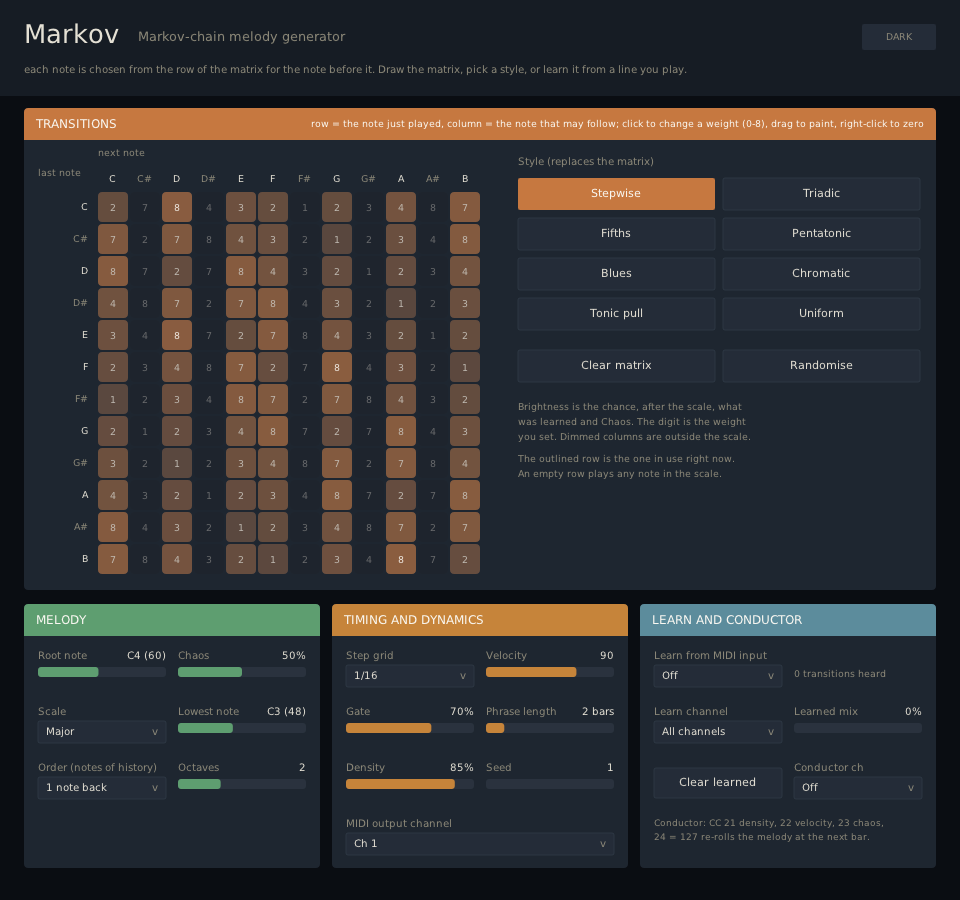
The melody is a random walk over the twelve pitch classes, counted from the Root note. The matrix on screen has a row for the note just played and a column for each note that may follow it; each cell’s weight (0 to 8) says how likely that move is. Brightness shows the chance each move actually has once the scale, anything learned and Chaos are applied, and the digit shows the weight you set. Click a cell to cycle its weight, drag on from a click to paint that weight into the cells you cross, and right-click a cell to zero it. The outlined row is the one being used right now.
Style replaces the matrix with a ready-made habit: Stepwise (seconds, with some thirds), Triadic (thirds and fifths), Fifths (fourths and fifths), Pentatonic, Blues (minor thirds and flat fifths and sevenths), Chromatic (a semitone crawl), Tonic pull (stepwise, but leaning toward the tonic, with the leading tone and fifth resolving home) and Uniform. Clear matrix zeroes it, which plays any note in the scale, and Randomise draws a new one.
Scale (the 24 canonical scales of docs/scales.md) removes every note outside it, so any
matrix, drawn or learned, stays in key. An empty row plays any note in the scale. Chaos is an
exponent on the weights: below 50% it sharpens the favourites, above it flattens them toward
uniform, and 50% leaves them as drawn. Order 2 uses the two previous notes where the plugin has
learned anything about that pair, and the ordinary matrix otherwise.
Notes are placed in the register by taking the octave nearest the previous note, inside Lowest note and Octaves. Density is the chance a step sounds, Gate its length, Velocity its loudness (the first note of a phrase and notes on the beat are accented), and Step grid the same twelve divisions as Sprout, including one bar.
Phrases and repeatability
The walk restarts every Phrase length bars from the tonic, seeded by the Seed and the phrase number. So every note is a pure function of its position: loops, a locate to the middle of a song, a different block size and an offline render all play the same notes. The tests check that starting playback at bar 3 plays exactly what a continuous run plays there.
Learning from MIDI
Switch Learn on and play (or route) a single melodic line into the input. Every note-on after the first is counted as a move from the previous note, relative to the Root, so octaves count as the same note. Learn channel limits it to one channel (0 = all). Counts from chords or several lines blur together, so feed it one line. The plugin keeps first-order counts for every pair and second-order counts for every triple.
Learned mix blends the first-order counts into the matrix, row by row and only where a row has heard something: 0% ignores them, 100% plays only what was heard where there is data. Order 2 uses the second-order counts directly. Clear learned forgets everything. The matrix on screen, the learned counts and the transitions-heard readout are all saved with the project.
Conductor integration
Set Conductor ch (0 = off, 1-16) to the channel Conductor uses (default 16). CC 21 drives Density, CC 22 Velocity, CC 23 Chaos, and CC 24 (value 127) re-rolls the melody: at the next bar line the phrase count starts again with a new random draw. CC 20 (Scene) is not used. See MIDI Mapping.
Notes
-
Every choice (Scale, Step grid, Order, Learn, Learn channel, Conductor ch and the MIDI output channel) is a drop-down list; the numeric controls are sliders.
- The editor does not move while a CC is driving a control (DPF has no DSP-to-panel path for that); the learned counts do update, a few times a second.
- Only the matrix goes from the editor to the plugin when you edit it, so a melody being learned at the same time is not overwritten.
- State: the model (matrix and learned counts) is saved as text; every setting is an ordinary host parameter. Output is MIDI only; route it to any instrument. Pair it with Retune and a per-channel-bend synth for microtonal Markov melodies.
Status
Core DSP, deterministic tests (under ASan/UBSan), the VST3 target and the panel are complete. Host validation in REAPER, and listening to which styles and orders sound good, are pending.