Instrument · Instrument
Magneto
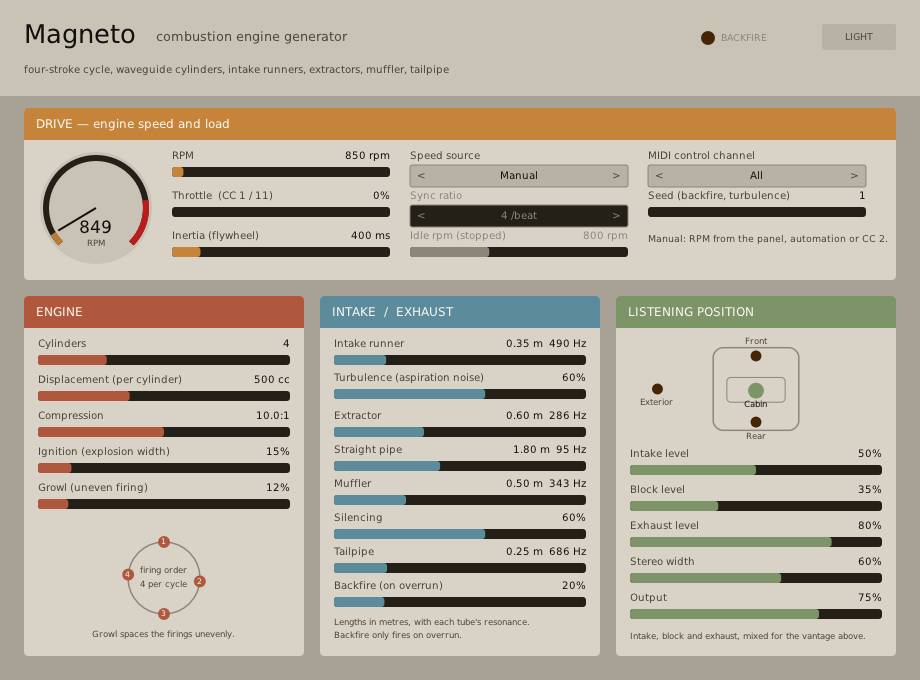
Physically informed four-stroke engine — waveguide cylinders, intake runners, extractors, muffler and tailpipe — driven by RPM and throttle, with a selectable listening position.
Opinion
The only thing in the set that makes a noise no synthesiser makes. Put it on Rear with Silencing near zero and a long Straight pipe and you have a muscle car; wind Growl up on eight cylinders and it lopes. It is also a fine drone source if you ignore what it is modelling — automate RPM slowly under a pad and it reads as machinery rather than music, which is exactly what some records need.
Functionality
Magneto synthesises a combustion engine from its mechanics, not from samples. It is a port of Baldan, Lachambre, Delle Monache and Boussard, Physically informed car engine sound synthesis for virtual and augmented environments (SIVE’15).
A phasor running at RPM/120 Hz — one ramp per engine cycle, which is two
crankshaft revolutions — drives four functions per cylinder: intake valve,
exhaust valve, piston motion and fuel ignition. Each cylinder is a bidirectional
digital waveguide: ignition is injected at the piston crown, the valves modulate
the reflection coefficients at the head, and the piston modulates the delay
length according to the compression ratio. Each cylinder feeds an intake runner
and an extractor; the extractors join a straight pipe, which feeds four
parallel muffler elements whose delays are snapped to prime sample counts so
their resonances never coincide, and then a tailpipe.
Three signals leave the model — the intake runners, engine-block vibration, and the tailpipe — and the listening position mixes and places them.
A MIDI note sets crankshaft speed rather than gating a voice, transposed down two octaves so the usable range sits comfortably on the keyboard: C1 idles near 980 rpm, C2 cruises at about 1960, C4 reaches the limit. With four cylinders the firing rate lands on the pitch actually played, and velocity sets engine load. Controllers cover the rest: CC 1 throttle, 2 RPM, 3 silencing, 4 growl, 5 straight pipe, 6 turbulence, 7 output, 11 throttle. The first four are the numbers Drift emits from its lanes by default, so Drift drives Magneto with no configuration.
Parameters
| Parameter | Range | Default | Notes |
|---|---|---|---|
| Cylinders | 1–12 | 4 | Firing rate is cylinders × cycle rate |
| Displacement | 100–1200 cc | 500 cc | Per cylinder; sets chamber resonance |
| Compression | 6–14 :1 | 10 | Depth of the piston delay modulation |
| Ignition | 2–100 % | 15 % | Width of the explosion impulse |
| Growl | 0–100 % | 12 % | Uneven firing intervals — the V8 and big-twin lope. CC 4 |
| Intake runner | 0.05–1.50 m | 0.35 m | Average length; runners detuned ±10 % |
| Turbulence | 0–100 % | 60 % | Aspiration noise at the intake valve |
| Extractor | 0.10–1.50 m | 0.60 m | Head to manifold |
| Straight pipe | 0.20–4.00 m | 1.80 m | Manifold to muffler |
| Muffler | 0.10–1.50 m | 0.50 m | Average of four prime-length elements |
| Silencing | 0–100 % | 60 % | 0 is straight through, 100 is silent. CC 3 |
| Tailpipe | 0.05–1.00 m | 0.25 m | Outlet after the muffler |
| Backfire | 0–100 % | 20 % | Only fires on overrun; each one makes the next less likely |
| RPM | 400–9000 | 850 | Manual mode. CC 2, or a MIDI note two octaves down |
| Throttle | 0–100 % | 0 % | Ignition energy and block vibration. Note velocity, CC 1 / CC 11 |
| Speed source | Manual, Host Sync | Manual | Sync derives engine speed from host tempo |
| Sync ratio | 1–16 cycles/beat | 4 | Target RPM is 2 × bpm × ratio |
| Idle | 400–1500 rpm | 800 | Held when the transport stops |
| Inertia | 10–3000 ms | 400 ms | Flywheel |
| Seed | 1–9999 | 1 | Turbulence and backfire streams |
| MIDI In | Off, 1–16, All | All | Channel filter for notes and controllers |
| Listen | Cabin, Front, Rear, Exterior | Cabin | Balance and stereo placement of the three sources |
| Intake / Block / Exhaust | 0–100 % | 50 / 35 / 80 % | Per-source levels |
| Width, Output | 0–100 % | 60 / 75 % | Stereo spread and output level |
Status
Core DSP, deterministic tests, the VST3 target and the catalogue screenshot are complete. Host validation in REAPER remains.