Processor · Audio effect
Grist
A grain delay. The input is cut into windowed grains, each with its own start, direction, length, position and pitch (optionally held to a scale), and the result can feed back through a filter.
Opinion
Not yet auditioned in a host. Expect it to be most at home on sustained or rhythmic material: with Density 2, Blur at 0 and Pitch at 0 it is transparent, and every control you add from there (Blur for smear, Range on a Scale for shimmering intervals, Reverse for swells, Feedback for trails) moves it further from the source.
It delays the sound by design, so it belongs on a send or a parallel track rather than across a part that has to stay in time. The panel shows the average latency.
Functionality
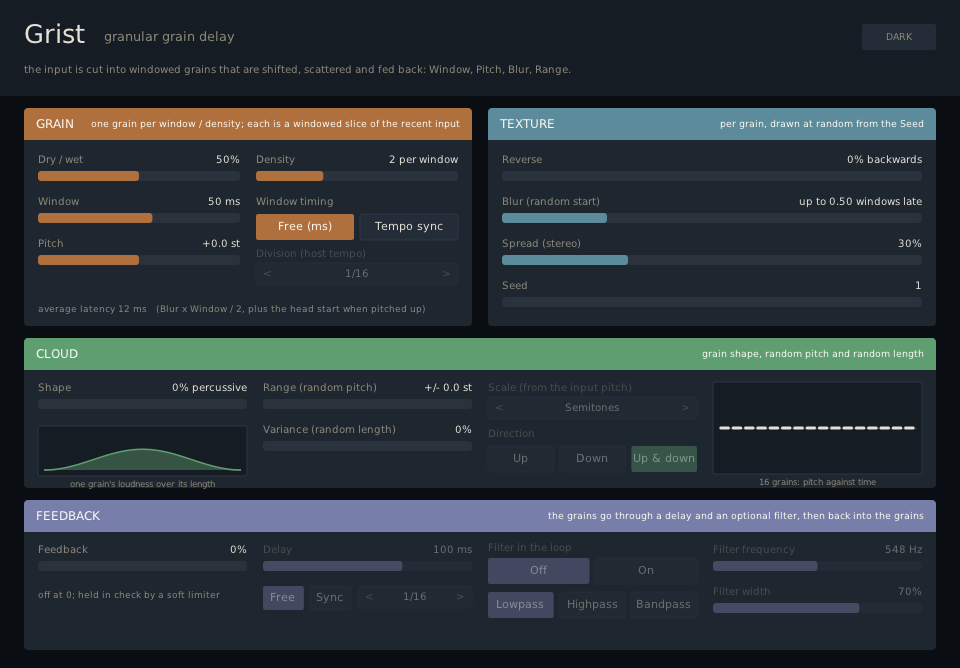
The input is recorded into a seven-second history. One grain starts every Window divided by Density, and each plays a slice of that history under a window shape, so grains keep scrolling even at Pitch 0. Window runs from 1 ms to 1 s, or from a tempo division (1/64 to 8/1, with triplets and dotted values) when set to sync.
Each grain draws its own values from a seeded generator, so a pass repeats exactly for a given Seed:
- Blur starts it a random distance back, up to the set number of windows.
- Reverse is the chance it plays backwards.
- Spread places it in the stereo field.
- Variance shortens it, down to a quarter of the window.
- Range moves its pitch up, down or both (Direction) by up to two octaves around Pitch. Scale limits where it can land: Free, Semitones, Octaves, Fifths and octaves, Major, Minor or Pentatonic, counted from the pitch of the incoming sound.
Shape blends a Hann bell with a percussive curve; both have the same average level. Pitching up needs a head start (a grain that read faster than real time would run into the present), so the average latency is Blur x Window / 2, plus (ratio - 1) x Window when pitched up. It is shown on the panel and is not reported to the host.
Feedback returns the grain output through its own Delay (free or tempo-synced) and an optional lowpass, highpass or bandpass filter, back into the history. A soft limiter keeps the loop bounded, but it can build, so trim the output.
With a resonator
Grist does no resonating of its own. For tuned, ringing results, put Resonance Garden after it: grains in, damped resonators tuned by held notes out. Moka does not fit this role, because it is a MIDI-triggered instrument with no audio input.
Beards is the other granular effect here. It adds freeze, reverb, a quality setting and Drift/Conductor control; Grist adds tempo-locked windows, a scale-aware pitch cloud and a filtered feedback loop.