Processor · Audio effect
Glue
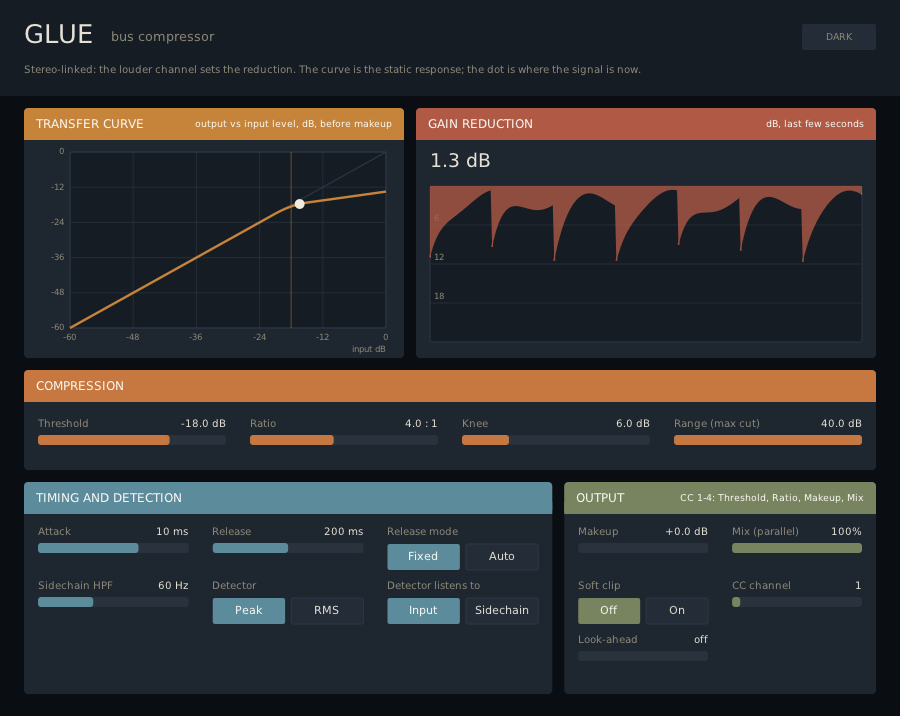
A stereo-linked bus compressor with a soft knee, sidechain high-pass, peak or RMS detector, program-dependent auto release, soft clip and parallel mix, showing its transfer curve and gain reduction.
Opinion
Not yet auditioned in a host. Downspout had gates, a ducker and a limiter but no general compressor, so this fills that gap: put it on a drum or mix bus with the defaults (4:1, soft knee, 60 Hz sidechain filter) and bring the threshold down until the gain-reduction history moves with the groove. It is a redesign, not a copy of the Oxide Studio compressor that inspired it, which has a hard knee, no sidechain filter and a soft clipper that is discontinuous and on by default.
Functionality
The detector takes the input, optionally high-passes it (so the bass does not pump the mix), measures peak or RMS level in each channel and uses the louder one, so the reduction is linked and the stereo image does not move. The gain computer is a textbook soft knee; the gain is smoothed in dB with separate attack and release.
Parameters
| Parameter | Range | Default | Notes |
|---|---|---|---|
| Threshold | -60 to 0 dB | -18 dB | |
| Ratio | 1.1 to 20 : 1 | 4 : 1 | |
| Knee | 0 to 24 dB | 6 dB | Soft knee centred on the threshold |
| Range | 1 to 40 dB | 40 dB | Caps the reduction |
| Attack | 0.1 to 100 ms | 10 ms | |
| Release | 20 to 2000 ms | 200 ms | Ignored while Release mode is Auto |
| Release mode | Fixed / Auto | Fixed | Auto is short after a transient and long once compression has been sustained |
| Sidechain HPF | 20 to 400 Hz (20 = off) | 60 Hz | Detector only; the audio is not filtered |
| Detector | Peak / RMS | Peak | RMS uses a 10 ms window |
| Makeup | 0 to 24 dB | 0 dB | |
| Soft clip | Off / On | Off | Linear below -6 dBFS; never exceeds 1.0 |
| Mix | 0 to 100 % | 100 % | Parallel compression |
| Detector listens to | Input / Sidechain | Input | Sidechain is inputs 3-4 (a host that connects nothing falls back to the input) |
| CC channel | 0-16 | 1 | CC 1-4 drive Threshold, Ratio, Makeup and Mix (Drift’s default lanes); 0 ignores MIDI |
| Look-ahead | 0-10 ms | off | Delays the audio, not the detector; the plugin reports the latency to the host |
Auto release
In Auto mode the release time runs from about 40 ms to 800 ms depending on how long the compression has been held. Measured: 63 % recovery in 196 ms after a 50 ms burst and 644 ms after 5 s of compression. The Release knob is ignored while Auto is on.
The panel
The transfer curve is the static response (before makeup); the white dot is the current input level and reduction, and lags the curve during transients. The history strip shows reduction hanging down from 0 dB. Both read gain reduction and level that the plugin measures from the audio.
Status
Core covered by tests (static curve on audio, soft knee, range cap, attack and release time constants, auto release, sidechain filter, stereo link, RMS against peak, mix, makeup, soft clip shape, meters, every control, stability and overload at 44.1 to 192 kHz, block-size independence, denormals, and the parameter table against the core), the external sidechain and the Drift CC mapping. Not yet listened to or validated in a host. Look-ahead is a delay on the audio path with the one-pole attack, so it is not a brick-wall limiter.