Processor · Audio effect
Chipper
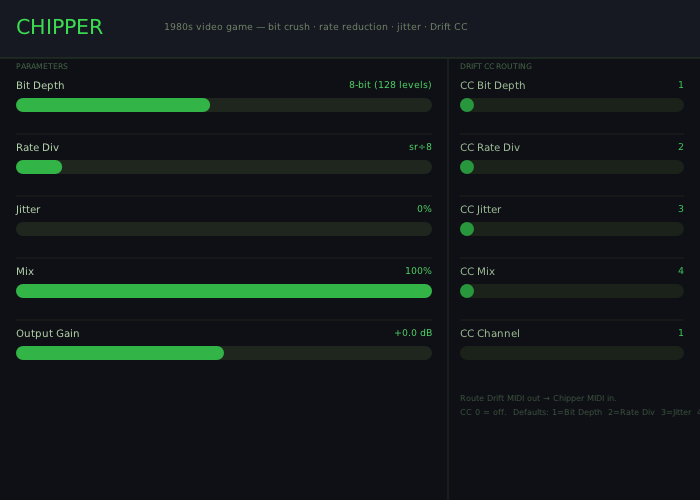
1980s video game lo-fi processor. Bitwise quantization (bit depth 1–16), sample-rate reduction via sample-and-hold (divisor 1–64), and randomised clock jitter for vintage digital harshness.
Opinion
The sample-rate reduction is the most characterful control — dropping to sr/8 gives instant Game Boy, sr/16 pushes into Atari territory. Bit depth works best below 6 bits where the quantisation noise becomes musically aggressive rather than merely grainy. Jitter is subtle at low settings but adds organic timing instability that separates Chipper from clinical bit-crushers.
Functionality
Chipper implements two classic lo-fi algorithms in series: a configurable sample-and-hold (sample-rate reduction with optional timing jitter) followed by uniform midtread quantisation (bit depth reduction). The order matches hardware sample-rate reduction circuits, which hold the analogue input before digitising.
Signal chain
Input → Sample-and-Hold (Rate Div, Jitter) → Bit Quantise (Bit Depth) → Dry/Wet Mix → Output Gain → Out
Parameters
| Parameter | Range | Default | Notes |
|---|---|---|---|
| Bit Depth | 1–16 bits | 8 | Quantisation resolution; 16 = no reduction; 8 ≈ original Game Boy DAC |
| Rate Div | 1–64 | 8 | Hold every Nth input sample; 1 = no reduction; sr/8 ≈ 6 kHz at 48 kHz |
| Jitter | 0–100 % | 0 % | Fraction of Rate Div randomised per hold cycle; 0 = deterministic |
| Mix | 0–100 % | 100 % | Dry/wet blend; 0 % passes input unchanged |
| Output Gain | −12 to +12 dB | 0 dB | Post-processing level trim |
| CC Bit Depth | 0–127 | 1 | MIDI CC# that overrides Bit Depth in real time (0 = off); default = Drift lane 1 |
| CC Rate Div | 0–127 | 2 | MIDI CC# that overrides Rate Div in real time (0 = off); default = Drift lane 2 |
| CC Jitter | 0–127 | 3 | MIDI CC# that overrides Jitter in real time (0 = off); default = Drift lane 3 |
| CC Mix | 0–127 | 4 | MIDI CC# that overrides Mix in real time (0 = off); default = Drift lane 4 |
| CC Channel | 1–16 | 1 | MIDI channel for all four CC overrides |
Drift routing
Route Drift’s MIDI output to Chipper’s MIDI input. With default settings, all four Drift lanes map directly: CC 1 → Bit Depth, CC 2 → Rate Div, CC 3 → Jitter, CC 4 → Mix. CC 0 disables the override for that parameter, restoring the panel value. Each CC value (0–127) is mapped to the full parameter range: bit depth 1–16, rate divisor 1–64, jitter 0–100 %, mix 0–100 %.
DSP notes
The sample-and-hold uses a per-channel held value updated every Rate Div frames. When Jitter > 0, a xorshift32 PRNG randomises the hold length by ±floor(jitter × rateDiv / 2) frames each cycle, simulating the clock instability of cheap 1980s DAC circuits. Bit quantisation uses midtread uniform rounding: round(x × 2^(N−1)) / 2^(N−1).
Status
Core DSP and tests are complete. Screenshot capture pending.