Processor · Audio effect
Bassops
Four-input sidechain ducker with optional harmonic stereo synthesis. A control signal (typically a kick-drum send) ducks the main stereo signal; the ducked result is summed to mono and the harmonics added by a waveshaper, high-passed at the cutoff, are decoded as a side signal that generates stereo width above it. The bass stays clean mono.
Opinion
Still new, I haven’t tested much. But it basically works, should be useful.
Functionality
Bassops combines two processing stages into a single plugin:
Sidechain ducker — the signal on inputs 3 and 4 feeds an envelope follower whose output controls a VCA over the main signal on inputs 1 and 2. Attack and release shape how fast the duck opens and closes. Duck Depth sets the maximum gain reduction at full sidechain amplitude.
Mono split and stereo synthesis — after ducking, the stereo signal is summed to mono (a mono track that only feeds one main input is treated as dual mono, so it is not 6 dB down). The delayed full-range mono is the centre of both output channels.
- An optional waveshaper distorts the mono signal. The harmonics it adds, high-passed by a linear-phase FIR at the M/S Cutoff, become the stereo-difference component after M/S decoding, creating stereo width above the cutoff.
At Side Shape 0 % there is no side component, so both output channels are identical copies of the mono signal at unity gain. Increasing Side Shape progressively drives the shaper into saturation and hard-clipping, producing increasing stereo width above the cutoff. The bass is always the clean mono signal. The cutoff is soft at low settings (129 taps), so it sets where the added harmonics start rather than a sharp crossover.
A Wet control blends the processed signal against the latency-compensated dry stereo input. This is the only route to preserve the original stereo content of the source; the wet path uses a mono sum and does not retain the input’s stereo difference.
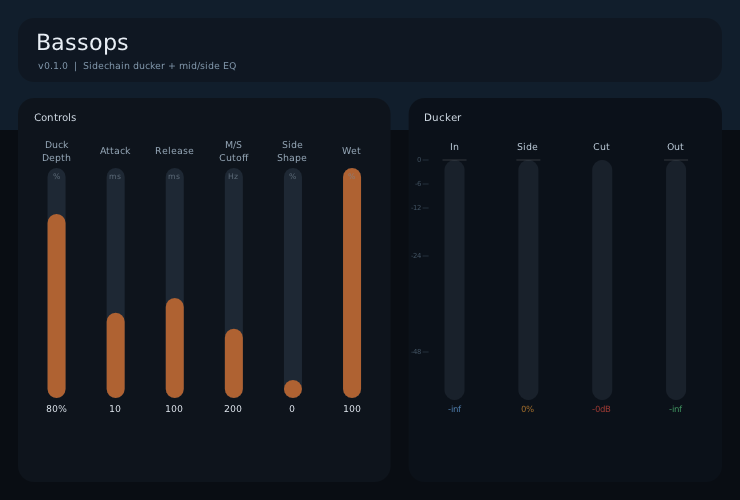
The right-hand panel shows four live meters — Input, Sidechain, Duck Gain, and Output — making the ducking action immediately visible.
Parameters
| Parameter | Range | Default | Notes |
|---|---|---|---|
| Duck Depth | 0–100 % | 80 % | 0 = bypass ducker; 100 = full silence on sidechain hit |
| Attack | 1–500 ms | 10 ms | Envelope follower rise time |
| Release | 10–2000 ms | 100 ms | Envelope follower fall time |
| M/S Cutoff | 50–5000 Hz | 200 Hz | LP/HP crossover; typical 80–300 Hz |
| Side Shape | 0–100 % | 0 % | Distortion on the HP path; 0 = mono output, 100 = hard clip ×8 drive |
| Wet | 0–100 % | 100 % | Wet/dry blend; dry is latency-compensated original stereo |
Routing
- Inputs 1–2 Main stereo signal to be processed.
- Inputs 3–4 Sidechain control signal (e.g. a dry kick-drum send).
- Outputs 1–2 Ducked, processed stereo output.
Use a dry kick send on inputs 3–4 rather than a processed bus. Applying heavy compression or limiting to the sidechain before it arrives will flatten the envelope follower’s response and reduce ducking clarity.
Latency
The FIR pair uses 128 taps (Hann-windowed sinc). This introduces 64 samples of latency, which is reported to the host so that automatic delay compensation keeps the track in time with other channels. The dry delay line matches this latency so wet and dry signals are time-aligned at any wet/dry ratio.
Status
Core DSP — envelope follower, FIR filter pair, waveshaper, and wet/dry mix — is tested. The UI is functional with live metering. The FIR coefficients are recomputed per-block on cutoff changes; rapid parameter automation may produce brief tonal artefacts at the crossover during the transition.